
13 min read
'%3e%3cg%20clip-path='url(%23b6dc094121)'%3e%3cpath%20fill='%230066cc'%20d='M%2012.707031%205.710938%20L%2012.707031%2035.761719%20L%2037.007812%2035.761719%20L%2037.007812%205.710938%20Z%20M%2012.707031%205.710938%20'%20fill-opacity='1'%20fill-rule='nonzero'/%3e%3c/g%3e%3c/g%3e%3cg%20clip-path='url(%23cd2e57bbdf)'%3e%3cg%20clip-path='url(%23cc31bb2a50)'%3e%3cpath%20fill='%230066cc'%20d='M%2026.734375%201.035156%20L%2026.734375%2035.761719%20L%2036.882812%2035.761719%20L%2036.882812%201.035156%20Z%20M%2026.734375%201.035156%20'%20fill-opacity='1'%20fill-rule='nonzero'/%3e%3c/g%3e%3c/g%3e%3cg%20clip-path='url(%23ab469c456a)'%3e%3cg%20clip-path='url(%23fb318aa8dc)'%3e%3cpath%20fill='%230066cc'%20d='M%200.0546875%201.035156%20L%200.0546875%2035.761719%20L%2010.203125%2035.761719%20L%2010.203125%201.035156%20Z%20M%200.0546875%201.035156%20'%20fill-opacity='1'%20fill-rule='nonzero'/%3e%3c/g%3e%3c/g%3e%3cg%20clip-path='url(%238fe1ac7b9f)'%3e%3cg%20clip-path='url(%23f68e7172d0)'%3e%3cpath%20fill='%230066cc'%20d='M%200%205.710938%20L%200%2035.761719%20L%2024.269531%2035.761719%20L%2024.269531%205.710938%20Z%20M%200%205.710938%20'%20fill-opacity='1'%20fill-rule='nonzero'/%3e%3c/g%3e%3c/g%3e%3c/svg%3e)
Money is not merely a tool that facilitates trade; it is one of the fundamental forces that shapes human history, economies, and civilizations.

Yağız Gürbüz
Founder & CEO

🎧 En iyi deneyim için kulaklık kullanmanızı öneririz
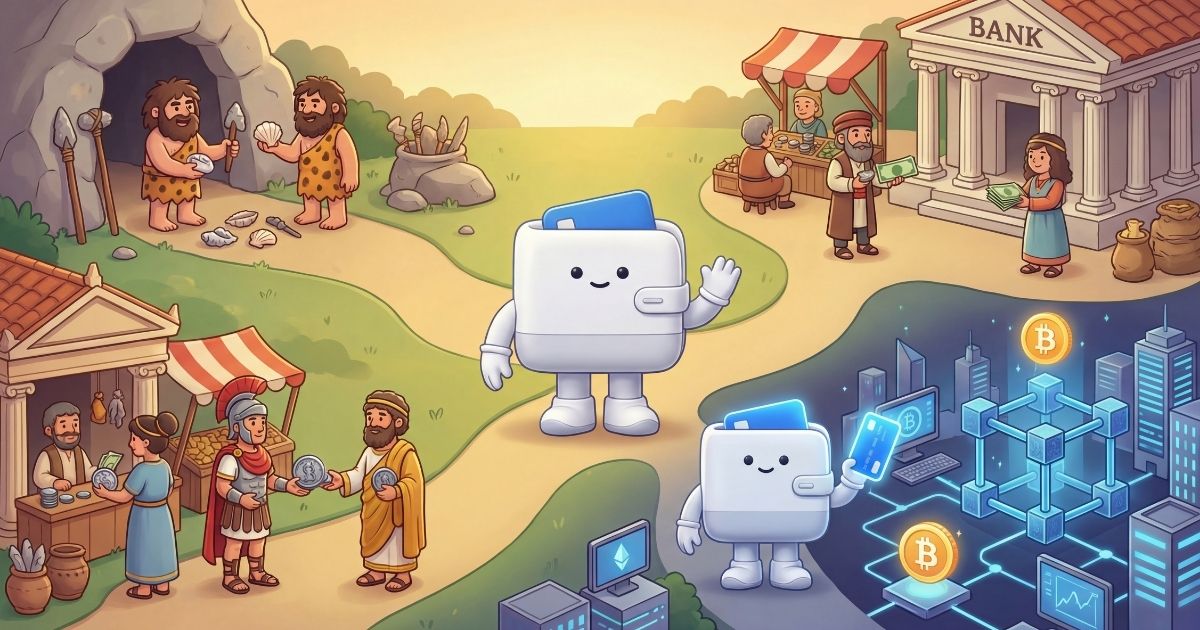
Money, one of the most essential economic tools in human history, has stood at the center of a fascinating journey—from the earliest barter systems to today’s world of digital currencies. As societies evolved, the concept of money transformed not only trade but also the balance of power and the fate of entire civilizations.
The definition of money goes far beyond being a mere medium of exchange. Over the centuries, it has taken on various forms and adapted to human needs. The paper banknotes we hold in our hands, the digital balances we see on smartphone screens, or blockchain-based crypto assets are all products of this millennia-long transformation. In this article, we will embark on a deep exploration into the history of money, its evolution, and its future potential.
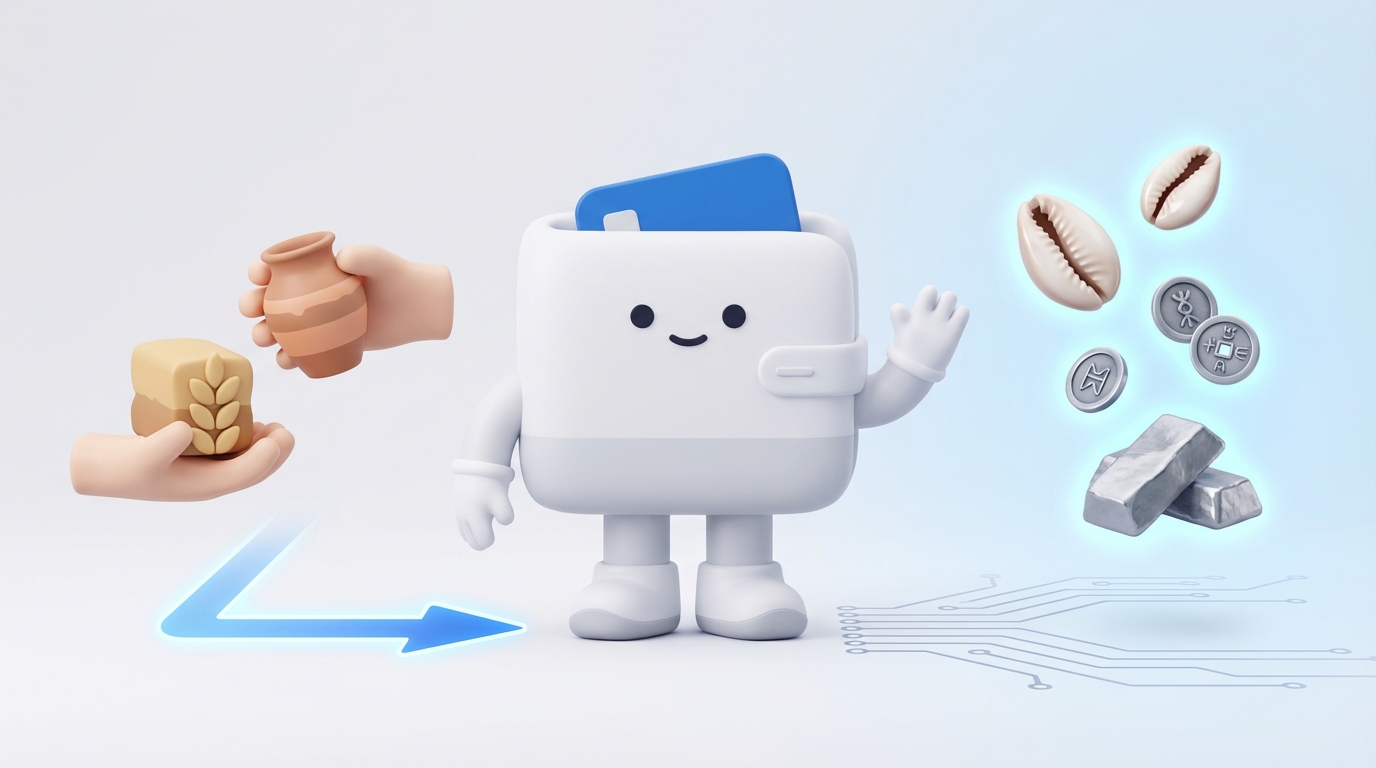
Before the invention of money, people met their needs through a barter system. In this system, individuals exchanged goods they owned for items they needed from others. For example, a farmer could trade wheat for pots made by a potter. While this method may seem simple, over time it revealed a range of significant challenges.
The flaws of the barter system became increasingly apparent. Not every product was universally desired, and some items were difficult to transport or compare in value. These issues made economic transactions inefficient. Perishability and indivisibility were also major obstacles. For instance, how could one fairly trade a sheep for a sack of wheat?
Due to these challenges, societies began to seek a more practical and universally accepted medium of exchange. This growing need led to the emergence of the earliest units of value, which can be considered the origin of money. People gradually shifted from pure barter to using standardized items that held agreed-upon value—allowing for smoother and more efficient trade.
These early forms of money marked a turning point in economic history, laying the foundation for the complex financial systems we rely on today.
 Walletlify AI tarafından üretildi
The limitations of the barter system eventually pushed people toward a more permanent and universal medium of exchange. This transition marks a major turning point in the evolution of money. Early societies began searching for items that could act as a consistent unit of value, replacing the inefficiencies of direct trade.
These early forms of money needed to be portable, durable, and widely accepted. In response, various civilizations adopted different objects as a form of commodity money. Agricultural societies used wheat or barley; nomadic tribes traded livestock; tropical communities valued seashells. Because these items were systematically used in trade, they came to be known as commodity money.
Commodity money refers to tangible goods that hold intrinsic value and can function as a medium of exchange. These items were not only useful in daily life but also served as tools for economic transactions. Examples of commodity money include gold, silver, wheat, salt, silk, and even animal hides, each used across various cultures as some of the earliest forms of currency.
The biggest advantage of commodity money was its universal recognizability and desirability. However, issues such as bulkiness, indivisibility, and difficulties in storage limited its practicality. For example, carrying 10 kilograms of wheat to a marketplace was cumbersome, and without standardized measurements, fair trade was hard to ensure.
Nevertheless, commodity money laid the foundation for more organized economies. It helped shape the idea of abstract value, a concept critical to the development of modern financial systems.
One of the most revolutionary moments in the history of money occurred in the 7th century BCE in Anatolia. The Kingdom of Lydia, located in what is now modern-day Turkey, was the first known civilization to mint metal coins. These coins were made from electrum, a natural alloy of gold and silver, and bore the stamp of the ruling king.
The introduction of coinage brought significant advantages to trade. Coins were easy to carry, durable, and most importantly, their value was guaranteed by the authority of the state. This meant that goods could now be valued in specific denominations, and people across regions could agree on a shared system of worth. Coins began to serve not just as tools of exchange, but as symbols of trust, stability, and political authority.
Lydia’s innovation quickly spread. Persians, Greeks, and Romans began minting their own coins, strengthening their economies and centralizing state power. In doing so, money transformed from a local tool into a universal language of trade and diplomacy across civilizations.
 Walletlify AI tarafından üretildi
The evolution of money is not limited to metal coins. Over time, technological advancements and growing economic needs gave rise to new forms of currency. One of the most significant developments in this process was the emergence of paper money, which brought increased convenience and allowed governments to exert greater control over monetary systems. In this section, we’ll explore where and how paper currency first appeared and how it eventually led to the establishment of central banks that laid the foundation of modern monetary policies.
The history of paper money dates back to 7th-century China. During the Tang Dynasty, transporting heavy metal coins became increasingly difficult for merchants, prompting a search for a more portable alternative. Merchants began depositing their coins and receiving written certificates in return. These documents soon gained acceptance as a medium of payment, representing the symbolic value of money.
True, government-backed paper currency first emerged during the Song Dynasty in the 11th century. These banknotes were issued and guaranteed by the central authority, marking one of the greatest revolutions in monetary history. The idea of paper currency spread westward via the Silk Road, reaching the Middle East and eventually Europe centuries later.
In Europe, Sweden became the first country to adopt paper money in the 17th century. It was later embraced by nations such as France and England, especially during times of expanding trade and the rise of banking. Paper currency became a preferred method of payment for both governments and individuals, paving the way for the modern financial systems we rely on today.
As the use of paper money became widespread, the need for centralized control over currency issuance became evident. This led to the creation of central banks. One of the earliest examples is Sweden’s Riksbank, founded in 1668. However, the most influential early central bank in a modern sense was the Bank of England, established in 1694.
Central banks play a key role in ensuring economic stability by regulating the money supply, setting interest rates, and maintaining control over inflation. They serve as guardians of national and global financial systems, promoting trust in the value of money. At this point, the answer to "What is money?" expands beyond physical notes and coins—it becomes a symbol of government authority, economic planning, and public confidence.
In today’s economies, the supply of money is shaped by the monetary policies of central banks. For instance:
These tools are now considered fundamental to the operation of the global financial system.
 Walletlify AI tarafından üretildi
By the 21st century, the evolution of money had entered a new phase—not only in physical form but also in the digital realm. Today, money is found more often on our screens than in our wallets. Modern financial systems are shaped not only by banknotes issued by central banks but also by digital transactions, virtual assets, and even algorithms.
So, what is money today? The answer is no longer limited to coins or paper bills. It now includes electronic transfers, mobile payment solutions, digital wallets, and blockchain-based assets. In this section, we explore how digitalization has transformed money, and the role cryptocurrencies play in this ongoing financial revolution.
Today, traditional banking has shifted from physical branches to digital platforms. With the rise of ATMs, internet banking, mobile apps, and contactless payment systems, money no longer needs to physically change hands to be exchanged. This shift offers enormous convenience for both individuals and businesses.
At the heart of this transformation is the concept of digital money. Although the balances we see in our bank accounts exist as mere numbers, they fully function as real currency. Through methods like wire transfers, instant EFT, and QR code payments, people can move thousands of dollars in just seconds. These advancements have made financial transactions faster, more transparent, and more accessible.
The global pandemic further accelerated the adoption of digital payment systems, making the transformation more permanent. Platforms such as Apple Pay, Google Wallet, Papara, Tosla, and Wise have almost eliminated the need for physical cash. Yet, an even more radical shift emerged with the rise of cryptocurrencies.
The launch of Bitcoin in 2009 did more than introduce a new currency—it marked the birth of an entirely new financial ecosystem. Bitcoin operates on a decentralized and transparent system, free from control by any government or central bank. The backbone of this system is blockchain technology.
A blockchain is a public ledger where every transaction is visible and immutable. Trust is no longer placed in a central authority, but in the strength of the technology itself. This revolutionary model sparked the development of hundreds of other cryptocurrencies, including Ethereum, Solana, and Ripple.
These digital assets are not just payment tools—they have evolved into investment vehicles and the foundation of decentralized finance (DeFi) applications. People now conduct financial transactions not only through banks, but also via smart contracts and digital wallets, reshaping the way we think about value and exchange.
Despite ongoing debates around volatility and lack of regulation, cryptocurrencies remain at the forefront of discussions about the future of money. They challenge traditional monetary systems and offer new possibilities for a more decentralized, tech-driven financial future.
 Walletlify AI tarafından üretildi
The question "What is money?" has evolved beyond history—it now extends into debates about the future. With the rapid pace of digitalization, many countries around the world are moving away from traditional cash-based systems. This transformation carries not only technological implications but also deep economic and political consequences.
So, will money become entirely digital? Or will physical cash still have a role to play? As we seek answers, it's clear we are standing at the threshold of a new chapter in the evolution of money.
Around the globe, central banks are developing their own digital currencies, known as Central Bank Digital Currencies (CBDCs). Unlike cryptocurrencies, CBDCs are government-controlled and legally recognized forms of digital money.
Examples include China’s digital yuan, the European Central Bank’s digital euro, and ongoing research into a digital dollar by the U.S. Federal Reserve. These currencies aim to make digital payments more accessible, reduce informal economies, and improve the effectiveness of monetary policy.
In modern financial systems, the widespread adoption of CBDCs could lead to profound changes. Citizens might interact directly with central banks, potentially weakening the intermediary role of commercial banks.
Cash usage is rapidly declining, especially in advanced economies. In countries like Sweden and Norway, nearly all daily transactions are conducted digitally. However, in many developing nations, limited internet access and low digital literacy still make physical currency a vital tool.
At the same time, artificial intelligence and big data are reshaping financial systems. Banks and fintech firms now use behavioral data to offer personalized credit scores, investment advice, and tailored financial products. Money is no longer just a medium of exchange—it has become a source of data.
As AI becomes more embedded in decision-making, it may influence how money is used and who gets access to it. While this could enhance financial inclusion, it also raises concerns about data privacy and security.
In the near future, several scenarios are possible:
In this light, the question “What is money?” may one day be answered like this: Money is no longer just a store of value, but a dynamic system powered by information, trust, and algorithms.
Throughout history, money has been more than just a medium for transactions. It has defined and shaped power structures. From class divisions to wars, alliances, and economic crises, money has often stood at the center of societal shifts.
Today, the definition of money has far surpassed its traditional role as a means of payment. Money is:
For example, the U.S. dollar is not only the currency of the United States, but also a symbol of global trade, economic dominance, and diplomatic influence. The designs, figures, and emblems printed on a currency often reflect a nation's history, values, and ideology, making money a cultural narrative in itself.
The sociological impact of money goes far beyond economics. It influences human behavior, shapes moral decisions, and profoundly affects people’s lives. During economic crises, individual psychology, public trust, and social dynamics are all deeply affected. This shows us that money is not merely an outcome—it’s often the main force shaping the process.
With the rise of virtual money, crypto-economies, and CBDCs, the very definition of money is shifting. In the future, money will not just be a tool—but a kind of algorithmic force embedded in our digital lives.
Many of the insights in this article are drawn from trusted sources and academic research. For those who want to explore further, here are some recommended readings:
In this article, we explored the question "What is money?" from not only a technical perspective, but also through historical, sociological, and futuristic lenses. The history of money reflects not only the progression of economics, but also the broader arc of human civilization—technological, cultural, and political.
👉 If you found this article valuable, consider sharing it to help more people understand the fascinating journey of money.
💬 Do you think the future will be fully digital? Share your thoughts in the comments!
Written by
Founder & CEO
Sharing knowledge on personal finance, budget management, and investment strategies to help you achieve financial freedom.