13 min read
'%3e%3cg%20clip-path='url(%23b6dc094121)'%3e%3cpath%20fill='%230066cc'%20d='M%2012.707031%205.710938%20L%2012.707031%2035.761719%20L%2037.007812%2035.761719%20L%2037.007812%205.710938%20Z%20M%2012.707031%205.710938%20'%20fill-opacity='1'%20fill-rule='nonzero'/%3e%3c/g%3e%3c/g%3e%3cg%20clip-path='url(%23cd2e57bbdf)'%3e%3cg%20clip-path='url(%23cc31bb2a50)'%3e%3cpath%20fill='%230066cc'%20d='M%2026.734375%201.035156%20L%2026.734375%2035.761719%20L%2036.882812%2035.761719%20L%2036.882812%201.035156%20Z%20M%2026.734375%201.035156%20'%20fill-opacity='1'%20fill-rule='nonzero'/%3e%3c/g%3e%3c/g%3e%3cg%20clip-path='url(%23ab469c456a)'%3e%3cg%20clip-path='url(%23fb318aa8dc)'%3e%3cpath%20fill='%230066cc'%20d='M%200.0546875%201.035156%20L%200.0546875%2035.761719%20L%2010.203125%2035.761719%20L%2010.203125%201.035156%20Z%20M%200.0546875%201.035156%20'%20fill-opacity='1'%20fill-rule='nonzero'/%3e%3c/g%3e%3c/g%3e%3cg%20clip-path='url(%238fe1ac7b9f)'%3e%3cg%20clip-path='url(%23f68e7172d0)'%3e%3cpath%20fill='%230066cc'%20d='M%200%205.710938%20L%200%2035.761719%20L%2024.269531%2035.761719%20L%2024.269531%205.710938%20Z%20M%200%205.710938%20'%20fill-opacity='1'%20fill-rule='nonzero'/%3e%3c/g%3e%3c/g%3e%3c/svg%3e)
The modern world is increasingly shaped by subscriptions, from streaming entertainment to productivity software. This shift has fundamentally altered how we manage our money, presenting both unprecedented convenience and new financial challenges. Understanding this evolving landscape is key to maint

Yağız Gürbüz
Founder & CEO

🎧 En iyi deneyim için kulaklık kullanmanızı öneririz
The modern world is increasingly shaped by subscriptions, from streaming entertainment to productivity software. This shift has fundamentally altered how we manage our money, presenting both unprecedented convenience and new financial challenges. Understanding this evolving landscape is key to maintaining healthy personal finances in the digital age.
The concept of recurring payments for ongoing access isn't new, but its digital manifestation has ushered in a truly transformative era. What began as a practical necessity for publishers has blossomed into a ubiquitous model spanning virtually every industry. This evolution reflects not just technological advancements, but also a fundamental shift in consumer preferences from ownership to access.
In essence, the subscription economy is characterized by a business model where customers pay a recurring price (typically monthly or annually) for access to a product or service. This contrasts with the traditional one-time purchase model. The modern iteration, however, is far more sophisticated, leveraging data, personalization, and seamless digital delivery to create sticky customer relationships and predictable revenue streams.
The earliest forms of subscriptions can be traced back to the 17th century with book publishing, allowing readers to receive installments of longer works or regular issues of periodicals. Newspapers and magazines quickly adopted this model, providing consistent content directly to subscribers' homes. This was a practical arrangement, guaranteeing a predictable revenue stream for publishers and convenient, regular delivery for readers. Over time, physical goods like milk, bread, and even records were delivered on a subscription basis, emphasizing convenience and regularity.
The true revolution, however, began with the advent of the internet and digital content. Software companies like Adobe pivoted from selling perpetual licenses to offering subscription-based access to their creative suite (Creative Cloud), transforming a high upfront cost into a more manageable monthly fee. The entertainment industry followed suit with services like Netflix, Spotify, and Hulu, which fundamentally changed how we consume movies, music, and television. No longer tied to physical media or scheduled broadcasts, consumers gained on-demand access to vast libraries of content, marking a pivotal shift from ownership to access.
Several powerful forces have fueled the exponential growth of the subscription economy. Foremost among these is convenience. In an increasingly busy world, consumers value services that simplify their lives, automate access, and deliver content or products directly to them without hassle. The ability to "set it and forget it" for essential services, or to instantly stream entertainment, is a powerful draw.
Another major driver is personalization. Modern subscription services leverage vast amounts of data to tailor content, recommendations, and even product selections to individual preferences. Think of Spotify's personalized playlists or Netflix's curated suggestions – these create a more engaging and sticky user experience. Furthermore, the shift from ownership to access plays a crucial role. Many consumers, particularly younger generations, prioritize flexibility and access to a wide variety of options over the burden and cost of outright ownership. Why buy a movie when you can stream thousands for a monthly fee? Why own software when you always have the latest version via subscription?
Modern subscription models share several defining characteristics that differentiate them from their historical predecessors. Firstly, they are typically digitally delivered or managed, even for physical goods, leveraging online platforms for sign-up, payment, and content delivery. Secondly, they emphasize recurring revenue for businesses and predictable access for consumers, fostering long-term relationships rather than transactional ones. Thirdly, flexibility is key; most modern subscriptions offer easy sign-up, cancellation, and often tiered pricing structures (basic, premium, family plans) to cater to diverse needs.
Finally, data analytics and personalization are at their core. These services continually collect data on user behavior, allowing them to refine offerings, improve recommendations, and create a more tailored experience, which in turn enhances customer loyalty and reduces churn. This data-driven approach allows for dynamic pricing, personalized marketing, and continuous product improvement, making them far more sophisticated than simple recurring payments.

While offering undeniable convenience, the proliferation of subscription services has fundamentally altered how individuals manage their personal budgets and perceive their spending. The shift from large, infrequent purchases to numerous small, recurring payments creates a unique set of challenges that can easily lead to financial oversight and unexpected drains on income.
Traditional budgeting often focuses on categorizing and tracking larger, more obvious expenses like rent, utilities, and groceries. Subscriptions, however, can easily slip under the radar due to their seemingly low individual cost and automated nature. This stealthy accumulation of expenses is one of the most significant impacts on personal financial management.
One of the most insidious effects of the subscription economy is the "illusion of low cost." A single subscription for $9.99 or $14.99 per month seems negligible on its own. It's often less than the cost of a single meal out or a trip to the cinema. However, these small amounts quickly accumulate. When you combine streaming services, music apps, cloud storage, fitness apps, meal kits, software licenses, gaming passes, and digital newspaper subscriptions, the total can easily reach hundreds of dollars per month. A person might subscribe to 5-10 such services without realizing that their combined monthly outflow could be equivalent to a car payment or a significant chunk of their rent. This cumulative spending often goes unnoticed until a budget review or a look at bank statements reveals a surprisingly large sum allocated to recurring digital services.
The sheer number and diverse nature of subscriptions complicate traditional budgeting methods. It's no longer just a few big bills; it's dozens of small, often irregular, payments. Some might bill on the 1st of the month, others on the 15th, and some annually. This makes it challenging to get a clear, real-time picture of exactly how much is being spent on subscriptions at any given moment. Manually tracking each recurring charge can be tedious and prone to error, leading many to simply ignore these categories in their budgets. Furthermore, the automatic nature of these payments means that the money leaves your account without you actively making a spending decision each time, reducing financial awareness and control. This lack of conscious spending can lead to a disconnect between perceived and actual expenditures, making it harder to stick to financial goals.
Historically, consumers would often make larger, infrequent purchases for things like software, movies, or even gym memberships. You'd buy a copy of Microsoft Office, a DVD, or an annual gym membership. This required a conscious decision to part with a significant lump sum of money. The subscription model shifts this to smaller, more frequent monthly outflows. While this can make premium services more accessible initially, it also means a continuous stream of deductions from your bank account. Psychologically, it's easier to justify a $10 monthly payment than a $120 annual one, even though the total cost is the same. This shift can mask the true financial commitment over the long term, making it harder to save for larger goals as disposable income is constantly being chipped away by these smaller, recurring charges.
The convenience of "set it and forget it" billing is a double-edged sword. While it saves the user from remembering to make payments, it also makes it incredibly easy to forget about services they no longer use or need. Free trials that automatically convert to paid subscriptions are a prime example of this trap. Users sign up for a trial, forget to cancel, and find themselves paying for a service they barely use, sometimes for months or even years. This "subscription creep" often goes unnoticed because the individual charges are small and blend in with other legitimate recurring bills. The cumulative effect of several forgotten subscriptions can add up to significant wasted money, directly impacting a household's financial health and its ability to allocate funds towards more meaningful savings or investments.

Despite the potential pitfalls, the subscription revolution isn't solely a financial drain. For consumers, the model offers a multitude of benefits that have fundamentally enhanced access, convenience, and value in various aspects of daily life. When managed effectively, subscriptions can be powerful tools that enrich experiences and provide predictable access to premium services that might otherwise be out of reach.
The core appeal lies in transforming traditional transactional relationships into ongoing partnerships, providing consistent value and often fostering a sense of community or belonging. This approach caters to a modern consumer's desire for flexibility, personalization, and immediate gratification.
Perhaps the most compelling benefit of subscriptions is unparalleled convenience and accessibility. Want to watch a specific movie? It's just a few clicks away on your streaming service. Need a new skill? Online learning platforms offer courses on demand. Looking for a new read? Digital book subscriptions provide instant access to vast libraries. This "on-demand" nature eliminates the need for physical purchases, travel, or waiting, integrating seamlessly into busy lifestyles. Furthermore, many services are accessible across multiple devices, from smartphones to smart TVs, ensuring content and functionality are available wherever and whenever needed. This ubiquitous access has democratized information, entertainment, and even professional tools, making them available to a broader audience than ever before.
While cumulative costs can be a challenge, individual subscriptions offer predictable monthly or annual expenses. This predictability can be a significant advantage for budgeting, provided the consumer is actively tracking and managing their subscriptions. Knowing exactly how much you'll pay each month for essential software, entertainment, or even a curated product box allows for better financial planning. Unlike unexpected repair bills or fluctuating utility costs, subscription fees are generally fixed, making it easier to forecast monthly outflows. For essential services, this predictability helps individuals budget effectively without the surprise of large, infrequent purchases, allowing for smoother cash flow management.
Subscriptions have democratized access to premium services and vast libraries of content that would be prohibitively expensive to purchase outright. Imagine buying every movie and TV show available on Netflix, or every song on Spotify – the cost would be astronomical. Subscriptions provide an affordable gateway to an immense wealth of digital content, high-end software, and specialized services. This access means consumers can enjoy top-tier entertainment, professional-grade creative tools, advanced fitness coaching, or niche educational content without the substantial upfront investment. This "access over ownership" model allows individuals to explore interests and utilize resources that might otherwise be out of reach financially, fostering personal and professional growth.
Modern subscription models are inherently flexible. Most services offer different tiers (basic, premium, family plans) allowing users to scale their subscription up or down based on their current needs and budget. Need more cloud storage for a big project? Upgrade for a month. Want to share a streaming account with family? Opt for a family plan. Conversely, if financial circumstances change or a service is no longer needed, most subscriptions can be easily cancelled without long-term contracts or penalties. This adaptability is a significant advantage, empowering consumers to tailor their spending and access to their evolving life circumstances, rather than being locked into rigid, long-term commitments. This agility supports a more dynamic approach to personal consumption and financial management.
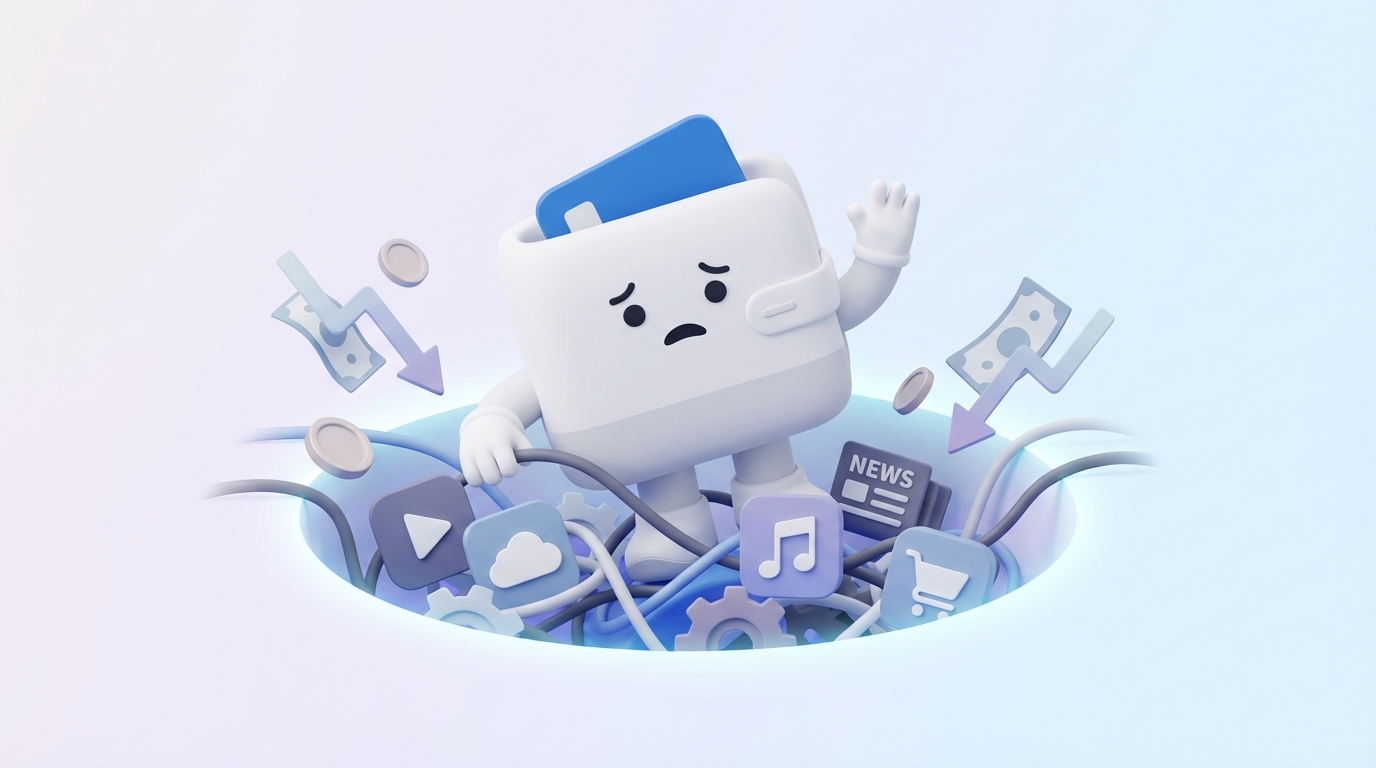
While the subscription economy offers many conveniences, its rapid expansion has also created a new landscape of financial challenges and pitfalls for consumers. The very mechanisms designed for convenience can, ironically, lead to financial disarray if not carefully managed. These downsides often stem from the sheer volume of available services, aggressive marketing tactics, and a lack of transparency in billing and cancellation processes.
Understanding these challenges is crucial for developing robust strategies to mitigate their negative impact on personal finance and prevent "subscription fatigue" from eroding financial stability.
As the number of subscription services skyrockets, consumers are increasingly experiencing "subscription fatigue." This refers to the mental and financial burden of managing too many recurring payments. It's not just about the money; it's also the cognitive load of remembering which service offers what, when each bills, and if they're still being used. This overload can lead to a sense of being overwhelmed, making it harder to make informed decisions about new subscriptions or to effectively manage existing ones. The sheer volume of choices and the constant barrage of new offerings can make consumers feel like they're missing out if they don't subscribe, contributing to an ever-growing list of recurring charges that they may not fully utilize or appreciate.
One of the most significant pitfalls lies in hidden costs and the often-sneaky practice of auto-renewals. Many services offer attractive "free trials" that automatically convert to paid subscriptions if not cancelled within a specific timeframe. These trials are frequently tied to a credit card, making the transition seamless and often unnoticed by the consumer until the first charge appears on their statement. Furthermore, annual subscriptions often auto-renew at the full price, even if a promotional rate was initially offered. Users might forget about these annual charges, leading to unexpected deductions from their bank accounts. Some services also employ tiered pricing with features locked behind higher-priced plans, making the initial "low cost" subscription less functional without an upgrade, effectively creating an upsell trap.
Effectively tracking all active subscriptions is a formidable challenge for most individuals. Payments often come from different bank accounts or credit cards, on varying dates, and sometimes under obscure billing names. This disorganization makes it incredibly difficult to maintain a comprehensive overview of recurring expenditures. Adding to this, many companies deliberately make cancellation processes convoluted and difficult. Users might have to navigate multiple menus, speak to a customer service representative, or even send a physical letter to cancel a service. This friction is designed to discourage cancellations, leading to consumers continuing to pay for services they no longer want or need simply because the cancellation process is too frustrating or time-consuming.
The cumulative effect of numerous small, recurring subscription fees can significantly erode disposable income, directly impacting an individual's ability to save and achieve long-term financial goals. Money that could be allocated to an emergency fund, retirement savings, debt repayment, or a down payment on a house is instead siphoned off by services that may provide diminishing returns. The psychological effect is also profound; because the individual charges are small, people often underestimate their total impact. This can lead to a false sense of financial security, where individuals believe they are managing their money well, only to find that a substantial portion of their income is disappearing into a black hole of digital subscriptions. Over time, this can severely hinder financial progress and delay the achievement of crucial life milestones.
Navigating the complexities of the subscription economy requires a proactive and strategic approach to personal finance. Without proper management, the convenience and benefits can quickly turn into financial burdens. Fortunately, there are actionable steps and tools available to help consumers regain control over their recurring expenses and ensure their subscriptions align with their financial goals and actual usage.
The key lies in regular review, diligent tracking, and conscious decision-making, transforming a passive spending habit into an active management process.
The first and most crucial step is to conduct a complete subscription audit. This involves gathering all bank statements, credit card statements, and PayPal records from the past 12-24 months. Go through each transaction line by line and identify every recurring charge. Create a master list that includes the service name, monthly/annual cost, billing date, and payment method. This exercise often reveals forgotten subscriptions or services you no longer use. It provides a clear, undeniable picture of your total subscription outflow, which can be a sobering but necessary wake-up call. Categorize these services as "Essential," "Nice-to-Have," or "Rarely Used/Unnecessary" to prepare for the next step of evaluation.
Given the difficulty of manual tracking, leveraging technology can be incredibly helpful. Several dedicated subscription management apps (e.g., Truebill, Rocket Money, Mint, YNAB) can link to your bank accounts and credit cards to automatically identify and categorize recurring payments. These tools often send alerts about upcoming renewals, rate changes, and can even help you cancel unwanted subscriptions directly through their interface. Some personal finance software also includes robust features for tracking recurring expenses. While these apps often come with their own subscription fees for premium features, the potential savings from identifying and cancelling forgotten services can far outweigh the cost.
Integrate your subscription spending into your overall budget. Instead of letting it be a hidden cost, create a specific budget category for "Subscriptions" or "Digital Services." Determine a realistic monthly or annual spending limit for this category based on your income and other financial goals. Once you've conducted your audit, you'll have a clear baseline. If your current spending exceeds your comfortable limit, you know you need to make cuts. Treat this category like any other variable expense; if you want to add a new streaming service, you might need to cancel an existing one to stay within your self-imposed limit. This conscious allocation forces you to prioritize and make deliberate choices about your digital consumption.
Make subscription review a regular habit, ideally quarterly or at least twice a year. During these reviews, ask yourself: Am I still using this service? Am I getting enough value to justify the cost? Can I get similar benefits for free or cheaper elsewhere? Be ruthless in cancelling services that don't meet your current needs or provide sufficient value. Don't be afraid to rotate services; for instance, subscribe to one streaming service for a few months, catch up on its content, then cancel and subscribe to another. Always mark your calendar for free trial expiration dates to avoid unwanted auto-renewals. When cancelling, be persistent, even if companies make it difficult; remember, it's your money.
There are often opportunities to save money on subscriptions through negotiation or bundling. Many telecommunication companies (internet, mobile) offer discounted rates if you bundle multiple services, sometimes including popular streaming platforms. Similarly, some credit card companies offer cash back or statement credits for specific subscription services. Don't hesitate to call customer service for services you value but find expensive; sometimes, they'll offer a loyalty discount or a lower-tier plan if you indicate you're considering cancelling. Students, military personnel, and seniors are often eligible for special discounts. Explore family plans for services like music streaming, which can be significantly cheaper per user than individual accounts. A little research and a willingness to negotiate can yield substantial savings over time.
The subscription economy is not static; it's a dynamic and rapidly evolving landscape, continually shaped by technological advancements, changing consumer demands, and innovative business models. As we look ahead, the intersection of subscriptions and personal finance promises even more sophisticated tools, hyper-personalized offerings, and new paradigms of consumption that will further redefine how we manage our money and access goods and services.
Anticipating these trends is crucial for individuals to adapt their financial strategies and remain financially resilient in an ever-more interconnected world.
The future of personal finance management will be heavily influenced by Artificial Intelligence. AI-powered tools will move beyond simply tracking subscriptions; they will actively analyze spending patterns, predict future subscription needs, and even automatically identify and suggest cancelling unused services. Imagine an AI assistant that not only flags an inactive subscription but also researches cheaper alternatives or bundles for services you frequently use. These tools could also provide hyper-personalized financial advice, recommending budget adjustments or savings strategies based on your unique subscription portfolio and financial goals. Furthermore, AI could help negotiate better rates with service providers on your behalf, taking the burden off the consumer to continually monitor and optimize their recurring expenses.
Subscription services are already personalized, but the future will bring hyper-personalization, driven by more advanced data analytics and AI. Instead of generic tiers, consumers might see dynamic pricing and content offerings tailored precisely to their individual usage, preferences, and even their current financial situation. This could mean highly specific content bundles, product deliveries based on real-time consumption data, or even services that adjust their fees based on your engagement levels. The challenge for consumers will be ensuring that this personalization genuinely adds value and isn't just a clever way to encourage more spending. There's also a privacy concern as more personal data will be collected to fuel these hyper-tailored experiences.
While the current trend favors comprehensive subscriptions, the future may also see a rise in "micro-subscriptions" or more granular pay-per-use models. Instead of subscribing to an entire news outlet, you might pay a few cents to read a single article. Rather than a full software suite, you might pay for a specific feature only when you need it. This shift could offer ultimate flexibility, allowing consumers to pay only for exactly what they use, thus minimizing waste. Blockchain technology could facilitate these micro-transactions securely and transparently. However, the downside could be an even greater fragmentation of spending, making tracking even more complex without sophisticated AI management tools. It could also lead to "decision fatigue" if every small interaction requires a payment decision.
As consumers become more conscious of their environmental and social impact, sustainability and ethical considerations will increasingly influence subscription choices. Subscriptions for eco-friendly products, services that promote fair trade, or platforms that prioritize data privacy and ethical AI will gain traction. Companies offering subscriptions will face pressure to demonstrate their commitment to sustainability, transparent labor practices, and responsible data handling. Consumers may be willing to pay a premium for subscriptions that align with their values, making ethical sourcing, carbon footprint, and corporate social responsibility key differentiators. This trend could lead to a more conscious and values-driven subscription economy, where personal finance decisions are intertwined with broader societal and environmental concerns.
The subscription revolution has profoundly reshaped the landscape of personal finance, transforming how we access goods, services, and entertainment. It offers unparalleled convenience, on-demand access, and often predictable costs, democratizing premium content and tools. However, this convenience comes with a significant caveat: the potential for cumulative spending to erode disposable income, the trap of forgotten auto-renewals, and the challenge of managing an ever-growing portfolio of recurring payments.
To thrive in this evolving environment, conscious financial management is paramount. Individuals must embrace proactive strategies such as conducting regular subscription audits, leveraging technological tools for tracking, setting strict budget limits, and making a habit of reviewing and cancelling unused services. The future promises even more sophisticated, AI-driven management solutions and hyper-personalized offerings, alongside new models like micro-subscriptions and a stronger emphasis on ethical consumption. Navigating this landscape effectively requires adaptability, diligence, and a commitment to understanding where your money truly goes. By striking a balance between enjoying the benefits of access and maintaining vigilant control over your expenditures, you can harness the power of the subscription economy to enhance your life without compromising your financial wellness.
Written by
Founder & CEO
Sharing knowledge on personal finance, budget management, and investment strategies to help you achieve financial freedom.